
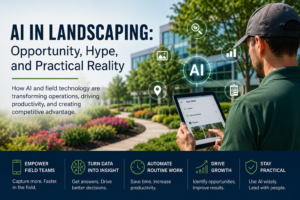
Artificial Intelligence is everywhere. Every week brings new announcements, new tools, and new claims about how AI will transform business. For commercial landscaping companies, the challenge is figuring out what is real, what is useful, and what is simply hype.
The good news is that AI will almost certainly create meaningful opportunities for landscaping companies. The bad news is that many organizations are likely to waste time and money chasing the wrong opportunities. The winners won’t necessarily be the companies that use the most AI. They’ll be the companies that use it in practical ways to improve productivity, service quality, and decision-making.
AI Is Part of a Larger Technology Wave
It is tempting to view AI as a revolutionary technology that stands alone. In reality, AI is part of a broader technology enablement wave that includes mobile applications, cloud software, automation, digital workflows, geolocation, image recognition, and data analytics. Taken together, these technologies are changing how landscape companies operate.
In many ways, this resembles the technology wave that swept through the industry in the 1980s, 1990s, and early 2000s. During that period, landscaping companies increasingly adopted accounting systems, estimating software, payroll systems, routing tools, and other back-office technologies that brought the industry into the 20th century.
Today’s technology wave is different. The focus is no longer primarily the back office. It is the field. For decades, many field processes remained largely unchanged. Site walks, quality inspections, customer communications, issue tracking, enhancement identification, and coordination between Account Managers, Operations Managers, and crews often relied on clipboards, notebooks, spreadsheets, emails, phone calls, and tribal knowledge.
Today’s technology wave is bringing those field processes into the 21st century. Mobile applications, digital workflows, AI-assisted data capture, mapping technologies, and real-time communication tools are enabling field teams to work more efficiently while creating operational visibility that simply did not exist before. Just as companies that embraced back-office technology gained advantages over competitors a generation ago, companies that embrace modern field technology are likely to gain advantages in efficiency, service quality, customer retention, and profitability over the next decade.
The companies that ignore these changes may find themselves at a growing competitive disadvantage.
AI Is Not a Magic Solution
One of the biggest mistakes companies make is viewing AI as a universal solution. AI is incredibly powerful in some areas and surprisingly weak in others. Like any tool, its value depends on how it is applied. The most successful companies are approaching AI with a practical mindset:
- Where can it save time?
- Where can it improve consistency?
- Where can it help employees make better decisions?
- Where can it remove repetitive work?
Those questions typically produce far better results than asking, “How can we use AI?”
The Best Uses of AI Today
1. Getting Answers from Your Existing Data
Most landscape companies already possess valuable information:
- Customer records
- Site audit data
- Work orders
- Enhancement history
- Renewal information
- Safety records
- Equipment maintenance logs
- Employee documentation
Unfortunately, much of that information is difficult to access and analyze. AI excels at helping people ask questions of large amounts of existing information.
Examples include:
- Which customers have generated the most enhancement revenue over the last three years?
- Which property managers tend to approve enhancements most frequently?
- What irrigation issues occur most often across our portfolio?
- Which branches have the highest renewal rates?
As more software vendors incorporate AI into their platforms, obtaining these answers will become dramatically easier.
2. Building Small Internal Tools
For companies with relatively few IT staff members, AI can be surprisingly useful for creating small utilities and extensions. Examples might include:
- Data import tools
- Reporting scripts
- Spreadsheet automation
- API integrations
Tasks that once required days of development can often be completed in hours. This may be one of the highest-return uses of AI for many landscaping companies.
3. Adopting AI-Enabled Software
Perhaps the easiest way to benefit from AI is through software products that already incorporate it. When AI is embedded within a well-designed workflow, users can often benefit without needing technical expertise.
For example, Operate uses AI to help Account Managers rapidly capture Issues and Enhancement opportunities during site walks. Rather than spending excessive time typing notes and creating documentation, users can quickly record observations while AI assists with organization and communication. The real value is not the AI itself. The value is making important field activities faster, easier, and more consistent.
Data Is the Fuel That Makes AI Valuable
One reality often gets overlooked in discussions about AI: AI is only as valuable as the data it can access. Many companies are eager to deploy AI but have not yet established consistent processes for capturing operational information in the field. If site issues, enhancement opportunities, quality observations, customer requests, and property conditions are not being captured consistently, there is little for AI to analyze.
The companies likely to benefit most from AI over the next decade are not necessarily those investing most aggressively in AI itself. They are the companies building systems and processes that generate high-quality operational data.
Good data creates visibility.
Visibility enables insight.
Insight drives better decisions.
AI simply accelerates the process.
Where Companies Often Get AI Wrong
1. Trying to Build Important Applications Through “Vibe Coding”
One of the most common misconceptions is that AI can replace professional software development teams. Can AI generate code? Absolutely. Can AI generate a useful application? Sometimes. Can AI generate a business class software platform that employees will reliably use every day? Much less often. The challenge is that coding is only a fraction of software development. Successful software requires:
- User experience design
- Workflow design
- Testing
- Security
- Integration
- Training
- Documentation
- Ongoing support
- Continuous improvement
Most business software projects fail not because the code doesn’t work, but because the software doesn’t fit how people actually work. User experience design remains far more art than science.
Just as importantly, most of the cost of business software occurs after the initial coding is complete. Maintenance, support, enhancements, user training, and ongoing administration typically consume far more time and resources than the initial development effort.
For most landscape companies, AI should be viewed as a force multiplier for internal IT resources—not a replacement for commercial software products that solve core business problems.
2. Trusting AI Without Verification
AI systems can be extremely convincing even when they are wrong. This phenomenon is often called “hallucination.” AI can:
- Misstate facts
- Invent sources
- Misinterpret data
- Draw incorrect conclusions
For this reason, important decisions should always be reviewed by knowledgeable employees. Whenever possible, use systems that can show where information came from and allow users to verify conclusions.
Buy Before You Build
As AI lowers the barrier to software development, more management teams are asking whether they should build their own solutions rather than purchase software. In most cases, the answer remains the same as it was before AI: buy before you build. Commercial software vendors spread development costs across many customers. They have typically invested years refining workflows, improving usability, handling edge cases, and supporting customers.
That does not mean custom development never makes sense. Some companies have unique processes or requirements that justify internal solutions. However, for most organizations, internal development efforts should focus on filling gaps, creating integrations, and extending existing systems rather than recreating entire platforms from scratch. AI makes that strategy even more effective by allowing small IT teams to build useful extensions and automations at a fraction of the historical cost.
A Practical Strategy for Landscape Companies
For most landscape companies, the best AI strategy is:
- Adopt technology that helps field teams capture better data.
- Leverage AI to extract insights from existing business information.
- Use AI to create smaller extensions and integrations.
- Buy before you build.
- Be cautious about large custom software projects.
- Always maintain human oversight for important decisions.
The companies that benefit most from AI will not necessarily be the most technical. They will be the companies that use technology to make their people more effective. In landscaping, success still comes from serving customers, delivering quality work, managing crews effectively, and building strong relationships. AI won’t change those fundamentals. But combined with the broader field technology transformation now underway, it can help your team perform them better than ever before.